How many cores is enough for server CPUs? All that we can get, and then some.
For the past two decades, the game in compute engines has been to try to pack as many cores and additional functionality as possible into a socket and make the overall system price/performance come down per unit of power consumed and heat dissipated.
The first dual-core processors entered the datacenter in 2001 before Denard scaling of chip clock speeds more or less ceased around four years later, which is the last free ride in architectural enhancements that chip architects had. Moore’s Law was still going strong back then, but was clearly entering middle age as the cost of transistors for each manufacturing node kept getting smaller and smaller, but at a decreasing rate. The cost per transistor started going up rather than down around the 10 nanometer barrier, and it will continue for the foreseeable future until we find an alternative to CMOS chip etching. Which probably means as long as any of us of a certain age will care.
And so, we want more and more cores on our compute engines, and the socket full of chiplets is becoming the motherboard, like a black hole sucking the surrounding components into it, because anything that can keep the signaling inside the socket increases computational and economic efficiency even if the move to chiplets is creating all kinds of havoc with power and thermals. The interconnects are eating an increasing share of the socket power budget, but moving to chiplets increases yield and therefore lowers manufacturing costs and allows a kind of flexibility that we think the industry wants. Why should your compute engine socket only come with components from one chip maker? Your motherboard never did.
It is with that backdrop and the desire to create better compute engines for AI inference and other more traditional workloads that Ampere Computing is hinting at future AmpereOne compute engines to come.
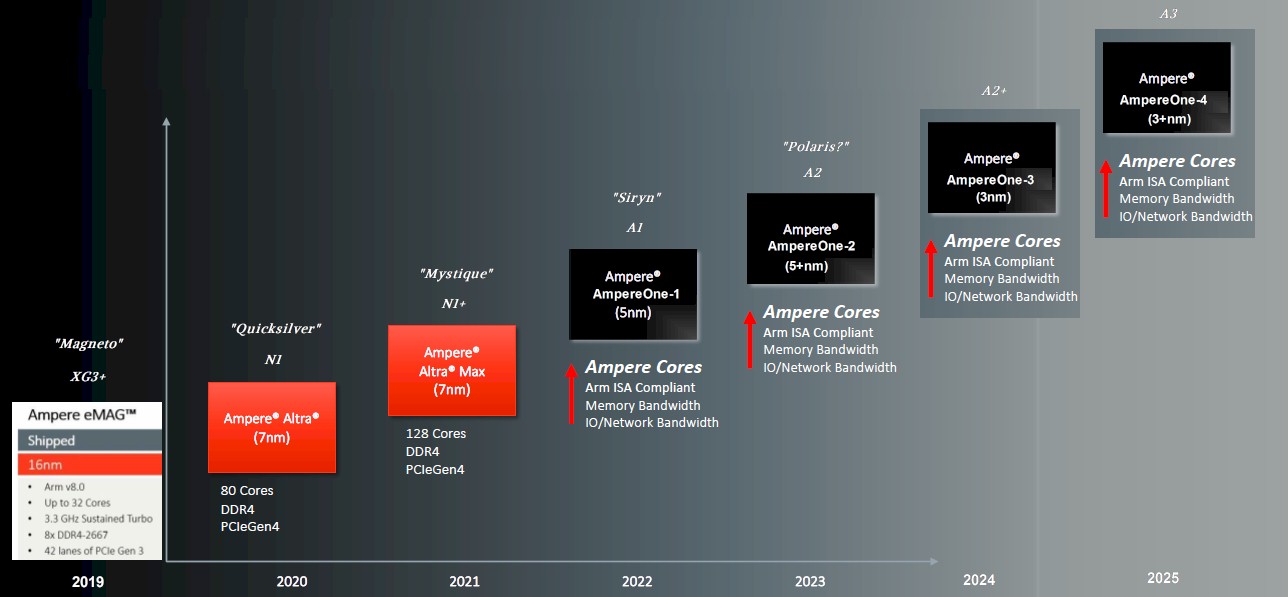
Ampere Computing started out using the X-Gene 3 cores created by Applied Micro, the original custom Arm server chip maker from the prior decade that formed a part of the foundation of Ampere when it was founded back in early 2018. We are smart-aleks here at The Next Platform, and we created an augmented Ampere Computing Arm server chip roadmap that included a codename of “Magneto” for those original eMAG chips from 2019, and we have put names on the homegrown cores used in the more recent AmpereOne processors as well as on the AmpereOne chip generations so we don’t all go mad trying to talk about the company’s chip lineup.
Here is our original story on the Ampere roadmap from back in May 2022, and just as a refresher here is that roadmap because it is relevant to the conversation we just had with Jeff Wittich, chief product officer at Ampere Computing, to get an update on progress on the AmpereOne roadmap.