NFC
Near-field communication (NFC) is a set of communication protocols that enables communication between two electronic devices over a distance of 4 cm (1.57 in) or less.[1]
The NFC Forum has helped define and promote the technology, setting standards for certifying device compliance.[3][4] Secure communications are available by applying encryption algorithms as is done for credit cards[5] and if they fit the criteria for being considered a personal area network.[6]
ISO/IEC
NFC is standardized in ECMA-340 and ISO/IEC 18092. These standards specify the modulation schemes, coding, transfer speeds and frame format of the RF interface of NFC devices, as well as initialization schemes and conditions required for data collision-control during initialization for both passive and active NFC modes. They also define the transport protocol, including protocol activation and data-exchange methods. The air interface for NFC is standardized in:
- ISO/IEC 18092 / ECMA-340—Near Field Communication Interface and Protocol-1 (NFCIP-1)[63]
- ISO/IEC 21481 / ECMA-352—Near Field Communication Interface and Protocol-2 (NFCIP-2)[64]
NFC incorporates a variety of existing standards including ISO/IEC 14443 Type A and Type B, and FeliCa (also simply named F or NFC-F). NFC-enabled phones work at a basic level with existing readers. In “card emulation mode” an NFC device should transmit, at a minimum, a unique ID number to a reader. In addition, NFC Forum defined a common data format called NFC Data Exchange Format (NDEF) that can store and transport items ranging from any MIME-typed object to ultra-short RTD-documents,[65] such as URLs. The NFC Forum added the Simple NDEF Exchange Protocol (SNEP) to the spec that allows sending and receiving messages between two NFC devices.[66]
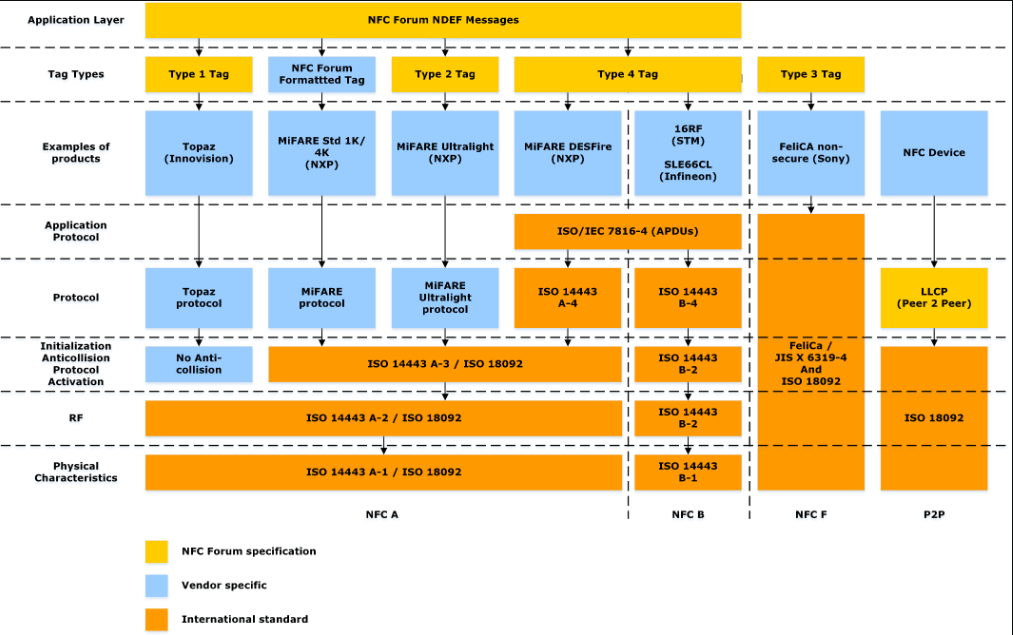
NFC employs two different codings to transfer data. If an active device transfers data at 106 kbit/s, a modified Miller coding with 100% modulation is used. In all other cases Manchester coding is used with a modulation ratio of 10%.
Every active NFC device can work in one or more of three modes:
- NFC card emulation Enables NFC-enabled devices such as smartphones to act like smart cards, allowing users to perform transactions such as payment or ticketing.
- NFC reader/writer Enables NFC-enabled devices to read information stored on inexpensive NFC tags embedded in labels or smart posters.
- NFC peer-to-peer Enables two NFC-enabled devices to communicate with each other to exchange information in an ad hoc fashion.
NFC tags are passive data stores which can be read, and under some circumstances written to, by an NFC device. They typically contain data (as of 2015 between 96 and 8,192 bytes) and are read-only in normal use, but may be rewritable. Applications include secure personal data storage (e.g. debit or credit card information, loyalty program data, personal identification numbers (PINs), contacts). NFC tags can be custom-encoded by their manufacturers or use the industry specifications.Posted from: https://en.wikipedia.org/wiki/Near-field_communication
Posted from: https://en.wikipedia.org/wiki/Near-field_communication