Active Directory Certificate Services (AD CS) is a crucial Windows server role, managing PKI (Public Key Infrastructure) on a network. It allows organizations to encrypt data, digitally sign files, and authenticate the identity of a user of a device using certificates. It is the latter “authentication of users” aspect we will be focusing on in this blog.
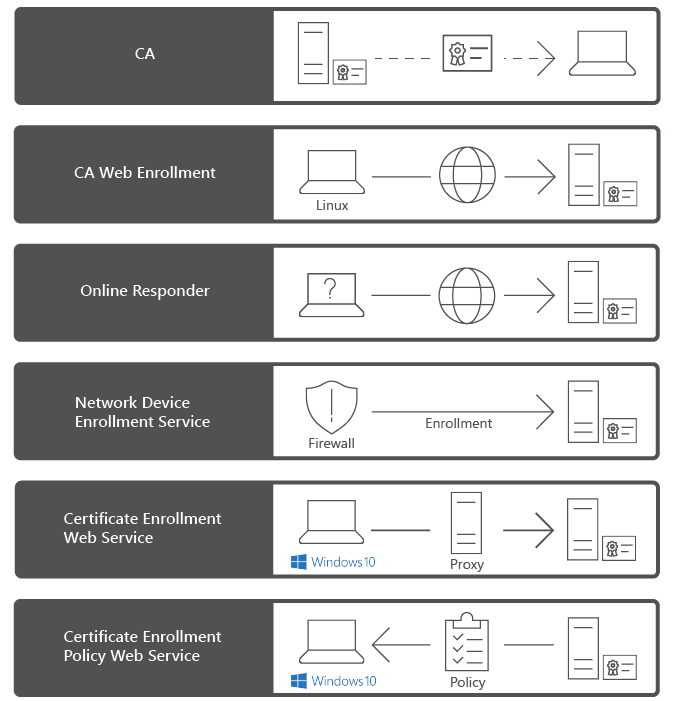
The AD CS role includes the following role services:
- Certification Authority. The main purposes of CAs are to issue certificates, to revoke certificates, and to publish authority information access (AIA) and revocation information. The first CA you deploy becomes the root of your internal PKI. Subsequently, you can deploy subordinate CAs, positioned within the PKI hierarchy, with the root CA at its top. Subordinate CAs implicitly trust the root CA and, by implication, certificates it issues. NoteYou have the option of deploying multiple internal CA hierarchies, each with its own root.
- Certification Authority Web Enrollment. This component provides a method to issue and renew certificates in scenarios where users use devices that are not joined to the domain or are running operating systems other than Windows.
- Online Responder. You can use this component to configure and manage Online Certificate Status Protocol (OCSP) validation and revocation checking. An Online Responder decodes revocation status requests for specific certificates, evaluates the status of those certificates, and returns a signed response that has the requested certificate status information.
- Network Device Enrollment Service (NDES). With this component, routers, switches, and other network devices can obtain certificates from AD CS.
- Certificate Enrollment Web Service (CES). This component works as a proxy client between a computer running Windows and the CA. CES enables users, computers, or applications to connect to a CA by using web services to:
- Request, renew, and install issued certificates.
- Retrieve certificate revocation lists (CRLs).
- Download a root certificate.
- Enroll over the internet or across forests.
- Renew certificates automatically for computers that are part of untrusted AD DS domains or are not joined to a domain.
- Certificate Enrollment Policy Web Service. This component enables users to obtain certificate enrollment policy information. Combined with CES, it enables policy-based certificate enrollment in scenarios where user devices are not joined to the domain or can’t connect to a domain controller.
More: https://www.beyondtrust.com/blog/entry/esc1-attacks
About CSR request ( Example of a PKCS #10 CSR ):
Active Directory Certificate Services documentation
https://learn.microsoft.com/en-us/windows-server/identity/ad-cs