Updated Exadata Platform Architecture
Oracle introduced several significant changes to the Exadata platform with the X10M. Oracle switched its design to use the AMD EPYC server processor, redesigned its cache architecture, and increased its capabilities along nearly every dimension.
AMD EPYC Processor
One of the most significant changes Oracle introduced is its switch from Intel Xeon to the latest generation AMD EPYC “Genoa” processors. Oracle told me that the latest generation AMD EPYC is “simply the best choice” for Exadata.
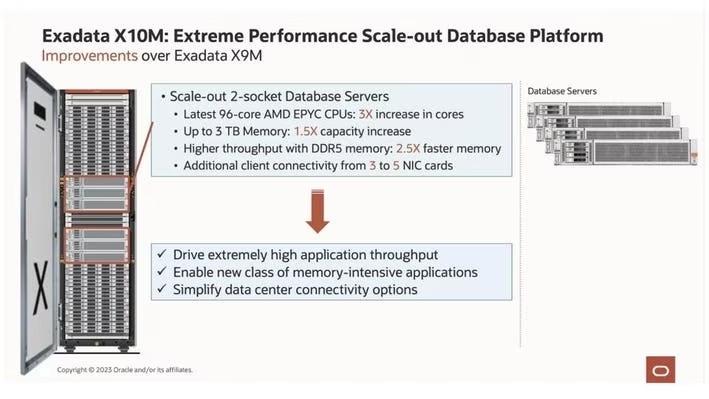
AMD’s latest generation AMD EPYC processor delivers the high-performance I/O required for high-performance OLTP-class databases. The new processor supports PCIe 5.0, which is double the speed of PCIe 4.0. It also supports DDR5, allowing for denser main memory that is nearly 2.5X faster than the previous generation DDR4.
Each 2-socket scale-out database server within the X10M is equipped with two 96-core AMD EPYC processors, a 3X increase in cores from the previous generation, with up to 3TB of DDR5 RAM. That alone is a significant performance boost from Oracle’s previous generation Exadata platform, but Oracle delivered even more.

Redesigned RDMA DRAM Cache
The X10M introduces a new cache architecture. The Exadata RDMA Memory (XRMEM) DRAM Cache interconnects each node’s DRAM cache across its internal fabric of RoCE RDMA ethernet. AMD’s PCIe 5.0 support should have no trouble delivering the throughput and latency required to keep the caches productive.
Exadata Storage Architecture
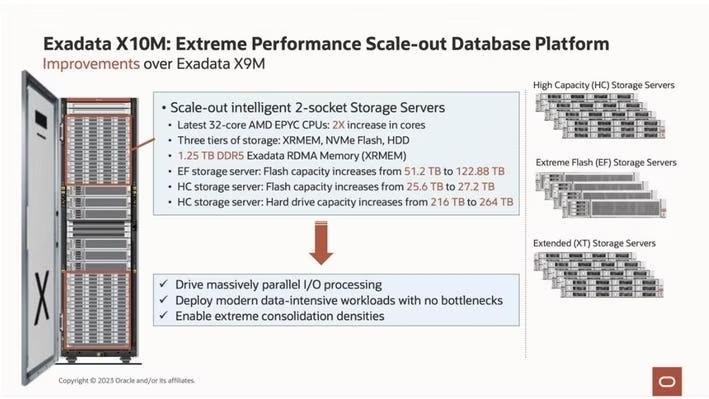
The X10M implements a three-tier storage system, automatically balancing persistent data where it’s most effective to support the current workload. The machine combines High Capacity (HC) storage servers for storing of large amounts of data in either flash or traditional hard drives, Extreme Flash (EF) storage servers for high-performance data access at the speed of flash, and Extended (XT) storage servers.
Oracle has increased its flash capacity in its EF storage servers from 51.2TB to 122.9TB and the HC storage server from 25.6TB to 27.2TB. The HDD capacity in its HC storage server grows to 264TB. That’s a lot of fast storage.
The X10M’s storage implementation delivers impressive results. The machine can provide up to 25.2M IOPS per rack with a read latency of as low as 17 microseconds. It can deliver up to nearly a TB/second of throughput. This alone makes the storage subsystem within the X10M one of the fastest storage solutions on the market.
A Performance OLTP Database Machine
The impact of the architectural changes becomes apparent when comparing the new Exadata X10M against the prior generation X9M. Oracle tells us that the new machine delivers up to 3X higher transaction throughput, 50% higher flash write IOPS, and up to 15% faster read IOPS and lower latency than the previous generation.
Translating those raw numbers into true benefit, the new Exadata X10M delivers up to 3.6X faster database queries, up to 2.6X faster storage server queries, and up to 2.4X faster in-memory analytics scans. I can’t find a metric in which the Exadata X10M isn’t better.
There is a lot to say about the raw performance of the Oracle X9M, and you can read about much of it on Oracle’s product page, but there’s more to the story.