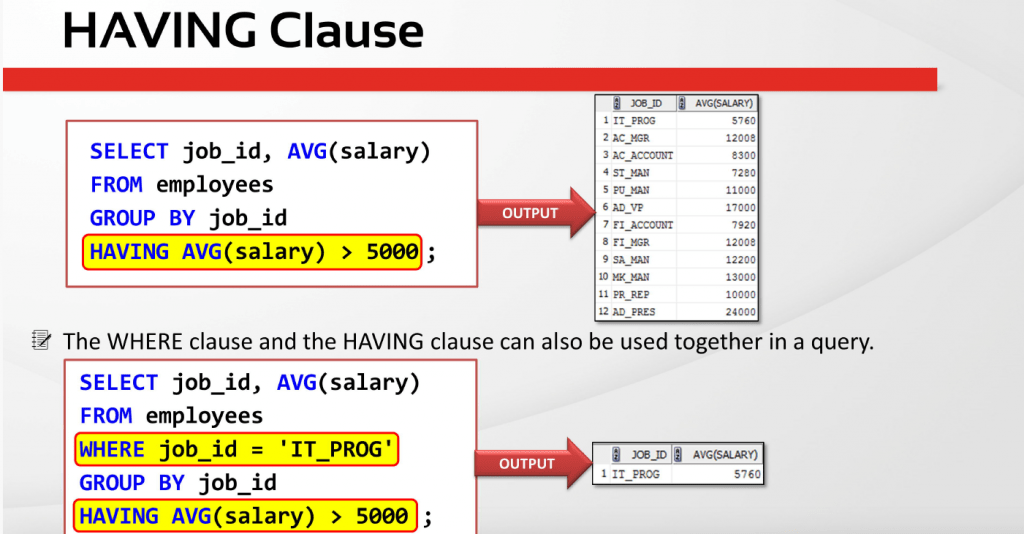
The HAVING clause is an optional clause of the SELECT statement. It is used to filter groups of rows returned by the GROUP BY clause. This is why the HAVING clause is usually used with the GROUP BY clause.
Posted from: https://www.oracletutorial.com/oracle-basics/oracle-having/


Which two statements are true about the WHERE and HAVING clauses in a SELECT statement? (Choose two.)
A. Aggregating functions and columns used in HAVING clauses must be specified in the SELECT list of a query
Primer :
SELECT dno, MIN(salary) AS “Lowest salary” FROM employee GROUP BY dno HAVING MAX(salary) > 40000
B. WHERE and HAVING clauses can be used in the same statement only if applied to different table columns
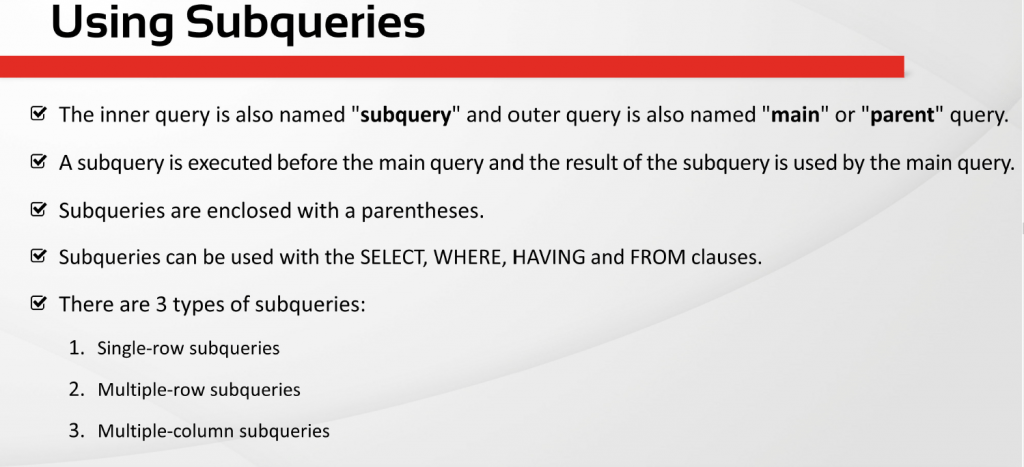
C. The HAVING clause can be used with aggregating functions in subqueries
D. The WHERE clause can be used to exclude rows before dividing them into groups
E. The WHERE clause can be used to exclude rows after dividing them into groups