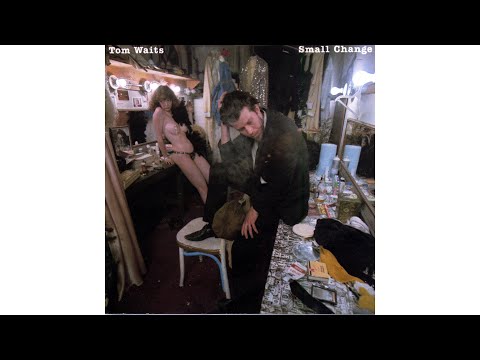
On February 23rd, “The Marsbar” spun a cover by British singer-songwriter Rod Stewart (b. 1945) of a composition by American singer, songwriter, composer and actor Tom Waits (b. 1949) and I was immediately drawn into the rich, orchestrated sound of Stewart’s take on the song. Waits wrote the song in 1976, basing his chorus on the Australian folk song, “Waltzing Matilda” (some refer to the original folk song as a subtitle, though it’s not part of the official name of Waits’ 1976 piece, but I suppose is an association that helps people remember it).
When listening to the cover I had a real sense of the emotional tone and mood of wartime songs from the time of World War II. However, Wikipedia tells me the original folk song dates further back to 1895 when Australians Christina Macpherson (a musician) and Banjo Paterson (a poet) wrote the ballad. Wikipedia also contains references to the title and storyline of the piece, saying it “…is a song developed in the Australian style of poetry and folk music called a bush ballad. It has been described as the country’s ‘unofficial national anthem.’
“The title was Australian slang for travelling on foot (waltzing) with one’s belongings in a ‘matilda’ (swag) slung over one’s back. The song narrates the story of an itinerant worker, or ‘swagman,’ making a drink of billy tea at a bush camp and capturing a stray jumbuck (sheep) to eat. When the jumbuck’s owner, a squatter (grazier), and three troopers (mounted policemen) pursue the swagman for theft, he declares ‘You’ll never catch me alive!’ and commits suicide by drowning himself in a nearby billabong (watering hole), after which his ghost haunts the site.” Quite a dramatic and tragic story I knew nothing about!
Posted from: https://songoftheday.ca/2024/03/04/tom-trauberts-blues-four-sheets-to-the-wind-in-copenhagen/
Tom Waits sings with a voice that has been around for eternities. And of all the songs he has sung, ‘Tom Traubert’s Blues (Four Sheets to the Wind in Copenhagen)’ feels like it has been around for an eternity too.
There’s whiskey on its breath and its hair is windswept as it waltzes its way through a classic melody, charting another sorry chapter in the perpetually unfurling human comedy. Tom Traubert is a familiar punchline. He just wants an easy life, free of the ambitions and goals that have always evaded him, but wanting an easy life is, in itself, an ambition.
In Australia, to ‘go waltzing matilda’ is to travel on foot with a backpack. But beyond that literalism, there’s also a sense of searching for opportunities. Old Traubert is beyond that, but he’s still forced to waltz all the same. His evenings succumb to drinking, and that furthers the sorrow of the morning, by afternoon he’s searching, and he seemingly finds a bottle again.
The familiarity of this punchline might have you thinking that poor old Traubert is a metaphor for the millions of souls who find themselves battling away against the sorrowful pitfalls of society. But the song is made a whole lot more poignant when you consider that Waits based the character on his friend. This isn’t a facsimile of fallen heroes, it’s an autobiography to someone.
Speaking to NPR, Waits explained, “He was a friend of a friend of mine… who lived in Denver, and died in jail. He’s a real guy. So, that’s a song that is about a lot of things, but mostly I think the idea that a Matilda is a backpack, so it’s aboutgoing on the loose, being on the road, chasing your dream.”
While he hasn’t disclosed too much more about his dear old pal, you get the sense that the dream he was chasing eluded him given that he died in a jail cell. At least, that certainly wouldn’t be your typical ‘happy ever after’. This is a detail that sharpens the sadness of the song. But it also typifies why Waits is such a brilliant artist.
You see, Waits does know these people and scenes that he sings of, and he’s never lost touch with them. He can perfectly encapsulate a vision of the forsaken underbelly of society because he knows the world so well. A swimming pool in Malibu has killed many great artists, none through drowning, but Waits has avoided those dastardly depths and stuck with the world that inspires him like a bug to Fly Stick Paper.
It’s not so much that he delves into the gutter on the hunt for songs, and more so that he slips out of one into a studio for a brief moment to chronicle the scenes he’s just seen. ‘Tom Traubert’s Blues’ is among his most heartfelt. It’s a tribute of the truest kind, not dressing up his fallen friend’s life or fabricating him a happy ending, but finding the art in it all the same. To some extent, that’s all any of us can wish for.
Posted from: https://faroutmagazine.co.uk/true-story-tom-waits-tom-trauberts-blues-four-sheets-to-the-wind-in-copenhagen/